

The most powerful AI
agent for music.
The only agentic AI tool built for music research. 92 tools across 17 sources. Influence tracing powered by Harvard research. A terminal agent and MCP server that understands music the way critics and collectors do.
92
Tools
17
Sources
26
Publications
What is Crate
The only AI agent
built for music.
Crate is the most powerful agentic AI tool for music research. It connects to 17 data sources — from MusicBrainz and Discogs to Bandcamp and Genius — giving you research-grade access to the full landscape of recorded music through a single conversation.
Ask anything
Natural language queries across every source. Who played drums on that session? What are the vinyl pressings worth? Where are they touring next?
Build playlists from verified data
Every track is verified against real databases — not hallucinated. Bandcamp, MusicBrainz, and YouTube confirm existence before inclusion.
Trace influence networks
Discover how artists connect through shared reviews, collaborations, and critical co-mentions. Powered by methodology from Harvard Data Science Review.
Listen right from the terminal
Built-in audio player streams tracks from YouTube and live radio from thousands of stations worldwide. Queue playlists, control playback, and discover new stations — without leaving the CLI.
Share your discoveries
Publish influence chains, artist deep dives, and playlists to Telegraph for instant shareable pages, or post to your Tumblr blog with full markdown formatting and auto-tagging.
Why Not ChatGPT
They guess.
Crate shows receipts.
General-purpose AI answers music questions from frozen training data. Crate searches 26 publications in real time and cites every connection back to the review, the critic, and the publication that documented it.
ChatGPT / Claude / Gemini
Training data
Answers from memorized patterns. No way to verify when or where a claim originated.
Invented tracks
Will confidently generate plausible-sounding track names for obscure artists that don't exist.
No sources
"Aphex Twin was influenced by Kraftwerk" — but which critic said that? Which review? No link, no proof.
Stateless
Every question starts from zero. No accumulated knowledge. No graph that grows over time.
One search provider
Generic web search, if any. No domain filtering to music publications.
Crate
Live sourced evidence
Searches Pitchfork, The Wire, Resident Advisor, and 23 more publications in real time. Every connection has a URL.
Verified tracks only
Every track is confirmed against Bandcamp, MusicBrainz, or YouTube before inclusion. No hallucinated tracklists.
Full attribution
Publication, article URL, author byline, and date for every claim. Click through and read the source yourself.
Persistent knowledge graph
Connections cache in a local SQLite graph. BFS path-finding gives instant results. The graph gets richer every session.
Dual-provider search
Tavily for keyword precision + Exa for neural semantic discovery. Both constrained to 26 music publications.
ChatGPT tells you what it thinks the connections are.
Crate shows you the reviews that prove it.
Category of One
Nothing else
like it exists.
We looked. Every other AI music tool focuses on creating music — generating beats, composing melodies, producing tracks. Not a single one is built for music research. Crate is the only agentic AI tool that connects to real music databases, traces influence through published criticism, and builds a knowledge graph from verified data.
Microsoft MusicAgent
AI Agent
Audio processing — classification, transcription, generation
Zero music research. No databases. Academic prototype, not a shipped product.
Suno / Udio / AIVA
AI Generation
Text-to-music generation — create songs from prompts
Creates music, doesn't research it. No data sources, no citations, no knowledge.
Discogs/Last.fm MCP
Individual Servers
Single-source API access for Claude Desktop
Disconnected building blocks. No cross-referencing, no agent, no unified workflow.
Crate
The Only One
92 tools, 17 sources, influence tracing, knowledge graph, audio playback, publishing
Every AI music tool makes music.
Crate is the only one that understands it.
Why Not Spotify's Algorithm
Algorithms follow crowds.
Crate follows critics.
Spotify's algorithm recommends music based on what millions of other people listened to next. That's great for mainstream hits — but it traps you in a feedback loop of the familiar. Crate discovers connections the way music critics do: by reading reviews, tracing lineage, and following the thread from one artist to the next through documented evidence.
Spotify / Apple Music / YouTube Music
Collaborative filtering
"People who listened to X also listened to Y." Follows the herd — surfaces what's popular, not what's influential.
Audio fingerprinting
Matches sonic similarity — tempo, key, energy. Misses artistic intent, lyrical lineage, and cultural context entirely.
Engagement-optimized
The algorithm rewards what keeps you listening longer, not what expands your knowledge. Designed for retention, not discovery.
Black box
"Because you listened to Radiohead" — but why this specific track? No explanation, no source, no way to understand the connection.
Platform-locked
Only sees its own catalog. Can't cross-reference Bandcamp exclusives, vinyl-only releases, or independent labels outside the platform.
Crate
Review-driven discovery
Connections extracted from 26 music publications. Every link traced to a specific review, critic, and publication date.
Cultural context
Understands why Fela Kuti influenced Beyoncé — the Afrobeat revival, the political messaging, the production choices. Not just "similar BPM."
Knowledge-optimized
Designed to make you smarter about music, not to keep you on a platform. Every session expands your understanding.
Full transparency
Every connection shows the evidence chain: which publication, which review, which critic, what they said. You can verify it yourself.
Platform-independent
Searches across 17 sources — Bandcamp, Discogs, MusicBrainz, YouTube, and more. Finds releases that don't exist on any single platform.
Spotify tells you what the crowd listens to.
Crate shows you what the critics wrote about.
MCP Server Mode
Use Crate anywhere.
Run crate --mcp-server to expose all 92 tools as a standard MCP server over stdio. Any MCP client — Claude Desktop, Cursor, OpenClaw, or your own agent — gets instant access to Crate's full music research stack. No TUI, no agent loop, just raw tools.
{
  "mcpServers": {
    "crate": {
      "command": "npx",
      "args": ["-y", "crate-cli", "--mcp-server"]
    }
  }
}{
"mcpServers": {
"crate": {
"command": "npx",
"args": ["-y", "crate-cli", "--mcp-server"],
"env": {
"ANTHROPIC_API_KEY": "${ANTHROPIC_API_KEY}",
"LASTFM_API_KEY": "${LASTFM_API_KEY}",
"GENIUS_ACCESS_TOKEN": "${GENIUS_ACCESS_TOKEN}"
}
}
}
}ClawHub Skill
Guided research workflows for OpenClaw
The MCP server gives your agent tools. The ClawHub skill teaches it how to use them — structured workflows for influence tracing, track verification, playlist building, and publishing. Artist research patterns that cross-reference MusicBrainz, Genius, Discogs, and Last.fm in the right order. Critical rules like “never hallucinate tracks” and “always cite the publication.”
Install
$ clawhub install crate-music-research
Data Sources
17 sources. 92 tools.
One conversation.
Metadata
MusicBrainz
6 tools
Independent
Bandcamp
7 tools
Collectors
Discogs
9 tools
Video
YouTube
6 tools
Scrobbles
Last.fm
7 tools
Lyrics
Genius
8 tools
Streaming
Spotify
4 tools
Encyclopedia
Wikipedia
3 tools
Analysis
SoundStats
3 tools
Live
Events
6 tools
Library
Collection
5 tools
Discovery
Web Search
4 tools
Research
Influence
3 tools
Network
Influence Cache
8 tools
Personal
Memory
3 tools
Publishing
Telegraph
5 tools
Blogging
Tumblr
5 tools
How It Works
Built on the
Claude Agent SDK.
Crate uses Anthropic's Agent SDK to orchestrate multi-turn research across all 17 sources. Claude decides which tools to call, chains results together, and reasons through complex queries — all in a single conversation loop.

Initial architecture diagram — some details have evolved since this was drawn.
Claude Agent SDK
Agent orchestration
Agentic query loop with streaming, session resumption, multi-turn tool use, and cost tracking.
Model Context Protocol
Tool interface
Each data source is an MCP server. Tools defined with Zod schemas, called by Claude at inference time.
pi-tui
Terminal UI
Imperative terminal rendering with live Markdown streaming, editor input, and custom themes.
Zod
Schema validation
Type-safe tool definitions ensure every MCP tool has validated inputs and outputs.
better-sqlite3
Local storage
Collections, playlists, and the influence network cache persist locally in SQLite.
Cheerio
Web scraping
Parses HTML from Wikipedia, Bandcamp, and other sources for structured data extraction.
Mem0
Long-term memory
Optional persistent memory layer that remembers your music preferences across sessions.
yt-dlp + mpv
Audio playback
Streams tracks from YouTube and internet radio directly in the terminal. No browser needed.
Telegraph API
Publishing
Anonymous, zero-friction publishing via Telegram's Telegraph platform. No API key, no account — instant shareable pages.
Tumblr API
Blogging
OAuth 1.0a publishing to your Tumblr blog. Markdown-to-NPF conversion with auto-tagging and category support.
TypeScript
Language
End-to-end type safety from tool schemas to agent responses. Strict mode, zero any.
Academic Foundation
Influence tracing,
grounded in research.
Crate's influence network is built on methodology from the Harvard Data Science Review — extracting artist connections from music criticism through co-mention analysis across 26 publications.
The Paper
“Modeling Artist Influence for Music Selection and Recommendation: A Purely Network-Based Approach”
Elena Badillo-Goicoechea · Harvard Data Science Review, Issue 7.4, Fall 2025
Proposes a recommendation system that builds a knowledge graph from music review text — mapping artistic influence through co-mentions in expert criticism rather than user behavior data. The approach emulates exhaustively reading through linked sequences of reviews, discovering new artists mentioned in each piece.
Read the paper →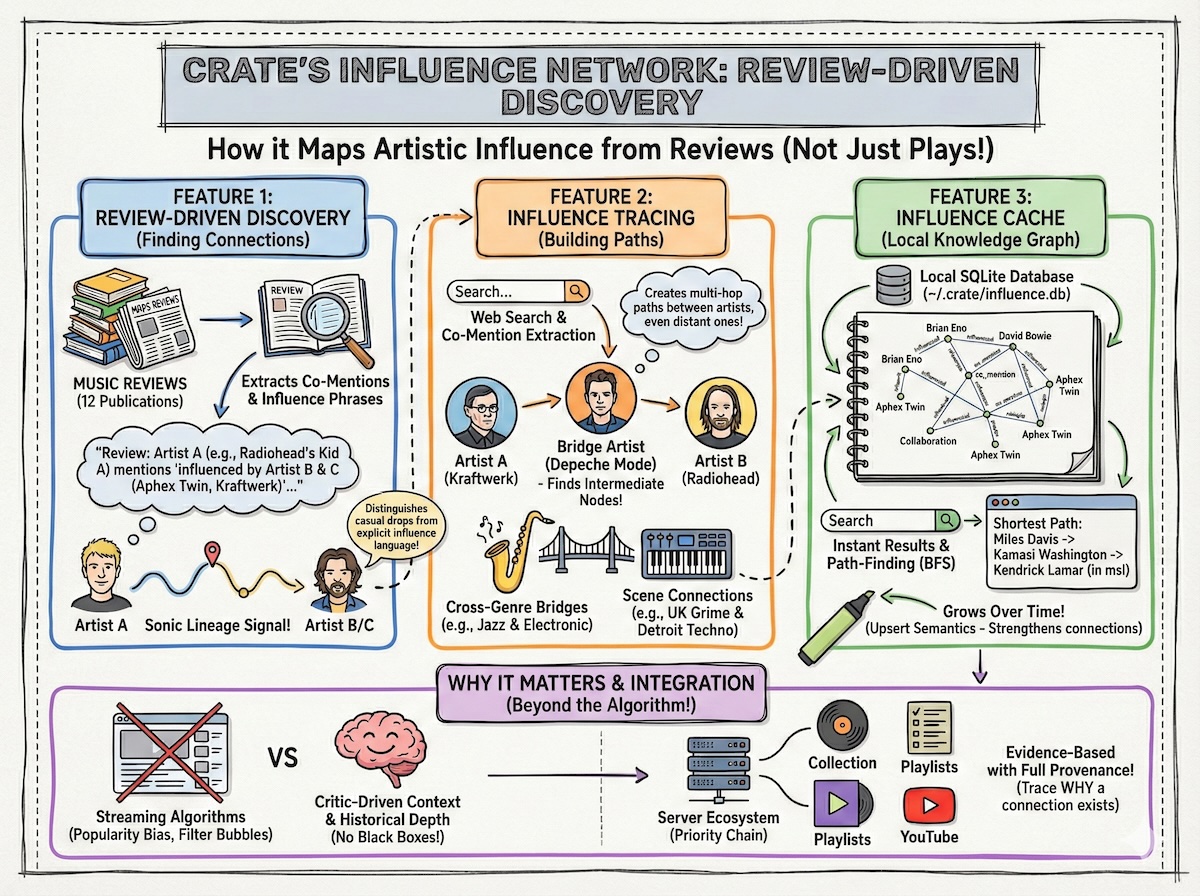
How Crate maps artistic influence from reviews — not streaming algorithms
Fela Kuti → Beyoncé — four influence paths, traced and cited
How It Works
01
Review-Driven Discovery
Searches 26 music publications for co-mentions and influence phrases. Distinguishes casual name-drops from explicit sonic lineage signals.
02
Influence Tracing
Builds multi-hop paths between artists — even distant ones. Finds bridge artists across genres using Exa neural search and Tavily keyword search.
03
Local Knowledge Graph
Every discovery is cached in a local SQLite graph database. BFS path-finding gives instant results. The graph grows stronger with every query.
26 Publications Indexed
Pitchfork
The Quietus
Resident Advisor
Stereogum
BrooklynVegan
FACT Magazine
NME
Consequence of Sound
NPR
The Guardian
Sputnikmusic
Goûte Mes Disques
Bandcamp Daily
Tiny Mix Tapes
Rate Your Music
AllMusic
The Wire
The FADER
Aquarium Drunkard
Boomkat
Passion of the Weiss
The Vinyl District
New York Times
Paste Magazine
Exclaim!
PopMatters
See it in action
Terminal-native.
Research-grade.
crate > trace the influence path from Brian Eno to Aphex Twin
Searching 26 publications for co-mentions...
Found direct connection via Pitchfork, The Wire
Extracting neighborhood (Exa neural search)...
Brian Eno → Aphex Twin
Confidence: 0.92 · Sources: 7 reviews
Shared themes: ambient, generative, texture-first
crate >
Getting Started
Start digging.
Open source. MIT licensed. One command to your first session.
$ npm install -g crate-cli
Requires Node.js 20+. Then just type crate to start. The setup wizard walks you through API keys on first run.
Try without installing
$ npx crate-cli
Clone for development
$ git clone https://github.com/tmoody1973/crate-cli.git
$ cd crate-cli && npm install && npm run dev
API Keys
configured in-app via setup wizard or /keysRequired — powers the agent
Web search for influence tracing
Listening stats, similar artists
Lyrics, annotations, artist bios
Vinyl catalog, labels, pressings
Neural semantic search
Improved search results
Publish research to your blog
Concert and event discovery
Only Anthropic is required. The setup wizard prompts you for keys on first run. Add or change keys anytime with /keys. For audio playback, install mpv and yt-dlp.